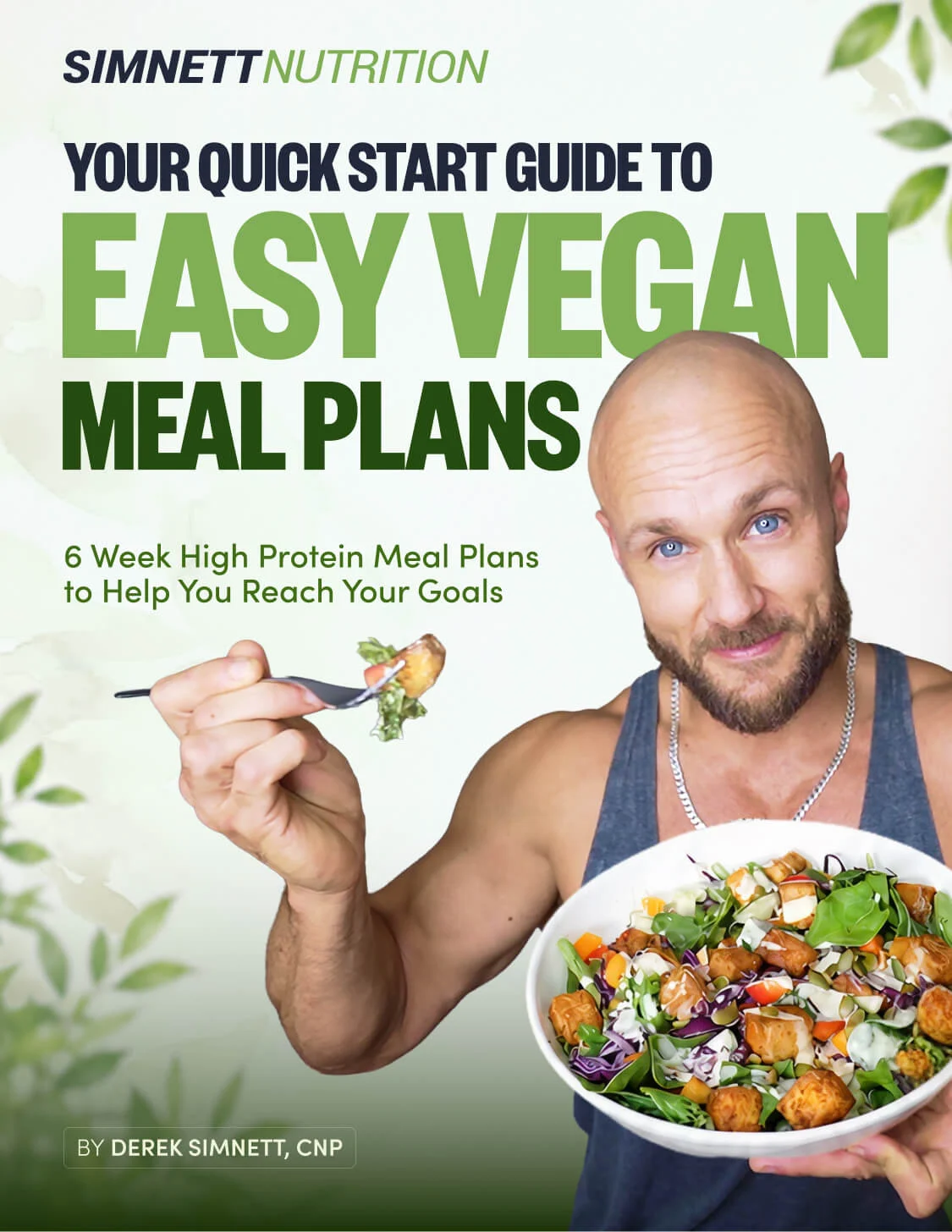

Welcome to the Simnett Nutrition Meal Plans
Hi, I'm Derek from Simnett Nutrition, and welcome to the Simnett Nutrition meal plans!
I created these meal plans to help make eating vegan easy and practical, whether your goal is to lose weight, build muscle, improve your nutrition, or simply spend less time wondering what to eat.
Inside this pack, you have access to five different calorie based meal plans:
The reason I included multiple calorie options is simple: everyone has different needs. Your body size, activity level, training, daily movement, goals, appetite, and lifestyle all affect how much food you need.
You can use these plans as written, or you can use them as a flexible framework to build meals that work for your life.
- 1500calories
- 1750calories
- 2000calories
- 2250calories
- 2500calories
These meal plans are intended for generally healthy adults. They are not medical nutrition therapy and are not meant to replace advice from a doctor, registered dietitian, or qualified healthcare provider.
If you are under 18, pregnant, breastfeeding, have a history of disordered eating, have a medical condition, or are unsure what calorie level is appropriate for you, please work with a qualified professional before following a structured meal plan.
You may also observe minor discrepancies when attempting to cross reference total caloric values by applying the standard Atwater general factors (the 4-4-9 rule: protein and carbs are 4 calories per gram, and fat is 9 calories per gram) to the listed macronutrient totals.
This variance is both normal and scientifically expected. While the 4-4-9 method serves as a simplified textbook estimation, the nutritional data in this meal plan is derived from Cronometer, an advanced nutrition database that utilizes the Atwater specific factor system.
My Philosophy Around Vegan Nutrition
My approach to nutrition is balanced, realistic, and performance minded.
I do not believe a vegan diet needs to be extreme. It does not need to be low carb, fat free, restrictive, or built around chasing the highest protein number possible. It also does not need to be perfect to be effective.
A well planned vegan diet includes all three macronutrients:
To support muscle, recovery, fullness, and overall health.
To fuel training, daily movement, energy, and performance.
To support hormones, absorption of fat soluble vitamins, satiation, and overall health.
- Around 20–30% of calories from protein
- Around 20% of calories from fat
- The rest from carbohydrates
Most days in these meal plans are built around a macro range similar to how I personally like to eat.
For many people coming from an omnivorous diet, vegan macros can look a little different at first. Whole plant foods like oats, rice, potatoes, fruit, beans, lentils, chickpeas, and whole grains naturally contain more carbohydrates than animal based foods.
That does not mean anything is wrong. Carbohydrates are not something to fear, especially when they are coming from mostly whole plant foods. They provide energy, fibre, vitamins, minerals, and they can help fuel your workouts and active lifestyle.
The main thing is that your overall diet is balanced, your protein intake is solid, your calories match your goal, and you enjoy the food enough to stick with it.
How to Choose the Right Meal Plan
The best meal plan in this pack to start with depends on your goal. You can use these plans for:
For weight loss, you generally want to eat slightly below your maintenance calories.
A moderate deficit is usually more sustainable than an aggressive one. The goal is not to eat as little as possible — it is to eat enough to support your energy, training, recovery, mood, and consistency while creating a reasonable calorie deficit.
For many people, this means starting around 250–500 calories below maintenance.
For maintenance, you want to eat close to the amount of calories your body uses each day.
This is a great option if you are happy with your current body weight, want to improve the quality of your diet, support your training, or simply want structure without focusing on weight change.
For building muscle, most people do best eating around maintenance or in a small calorie surplus.
You do not need a huge surplus to build muscle. A small increase, combined with progressive strength training, enough protein, sleep, and consistency, is usually the best place to start.
For many people, this means eating around 100–300 calories above maintenance.
Understand Your Calorie Needs
To choose the best meal plan to start with, it helps to understand BMR and TDEE. These will help you figure out what calorie meal plan is best for you to start with depending on your goal.
The estimated number of calories your body burns at rest just to keep you alive. This includes breathing, circulation, body temperature regulation, brain function, and basic cellular processes. Your BMR does not include any exercise or daily movement.
The estimated total number of calories you burn in a full day. It includes your BMR plus exercise, walking and daily movement, work and chores, digestion, and general activity. TDEE is often called your maintenance calories.
One commonly used formula is the Mifflin-St Jeor equation. First, use metric measurements — weight in kilograms, height in centimetres, and age in years.
To convert: pounds to kilograms — divide by 2.2. Inches to centimetres — multiply by 2.54.
These equations are still estimates, but they can give you a useful starting point.
Apply an Activity Multiplier
Once you have your BMR, multiply it by an activity factor. This gives you an estimated TDEE. From there, you can choose your starting meal plan based on your goal.
Let's say someone estimates their TDEE to be around 2200 calories per day. If their goal is weight loss, they might start with the 1750 or 2000 calorie plan. If maintenance, the 2250 calorie plan. If building muscle, the 2250 or 2500 calorie plan. This is just a starting point — the best plan is the one that supports your goal while still feeling sustainable.
Find Your Starting Plan
Use this as a general starting point. Match your estimated TDEE to your goal to find the calorie plan that fits.
If your calorie needs are higher than 2500, you can still use the 2500 calorie plan as a base and add extra food as needed — like a snack or another meal.
If your estimated needs are lower than 1500, do not automatically assume you need to eat less. It may be better to use the 1500 calorie plan as a structured base and work with a qualified professional for individual guidance.
How Long to Follow a Plan Before Adjusting
Try not to judge the plan based on one day or even a few days. Body weight naturally fluctuates due to water, sodium, digestion, hormones, training, soreness, stress, and carbohydrate intake. A better approach is to follow your chosen plan consistently for 2–4 weeks, then look at the overall trend.
- Is my body weight trending in the direction I want?
- Is my energy good?
- Am I recovering from workouts?
- Am I overly hungry or feeling restricted?
- Am I enjoying the meals?
- Is this plan realistic for my lifestyle?
If nothing is changing after a few weeks, move down one calorie level or look at portion sizes, snacks, drinks, and extras.
If you are losing weight, move up one calorie level or add a snack to your day.
If your weight is not increasing after a few weeks, move up one calorie level or add extra calories around training. Make sure you are working out hard enough to see progress.
If your energy, mood, sleep, or performance are suffering, that is useful feedback too. The right plan should support your life, not make you feel run down.
How to Use the Meal Plans
You can follow the meal plans exactly as written, or you can make simple swaps.
Every meal for each meal plan is a certain number of calories (for example, all of the meals in the 1500 calorie meal plan are 500 calories each). This makes it very easy to switch up meals and not worry about messing with the overall calories for the day.
You do not need to eat different meals every single day to be healthy. Repeating meals can make nutrition easier, cheaper, and more consistent — this is why I have structured the meal plans to include recipes that are used more than once.
These plans are designed to give you structure, but you are allowed to be flexible.
Don't panic. One meal does not make or break your progress. One day does not ruin anything. The best thing you can do is get back to the meal plan at the next meal.
Avoid the all-or-nothing mindset. You do not need to “make up for it” by skipping meals or being extra strict the next day. These meal plans are designed to help you with long term consistency, which matters way more than short term perfection.
My Final Thoughts
My hope with these meal plans is that they make vegan eating feel easier, enjoyable, and fun. You do not need to have everything figured out before you start. You do not need to track perfectly, eat perfectly, or follow every meal exactly as written to benefit from these plans. Use them as a guide, learn what works for your body, and make adjustments as you go.
Whether you are using these plans for weight loss, maintenance, building muscle, or simply getting more organized with your nutrition, remember that consistency matters more than perfection.
Start where you are, choose the plan that best matches your needs, and repeat the meals you enjoy. Make swaps when needed and, as always, keep showing up.
A healthy vegan lifestyle does not have to feel complicated or restrictive. With a little structure and some simple, nourishing meals, it can become something that feels natural, sustainable, and really enjoyable.
I'm excited for you to get started!